

Mitsubishi Catalytic Converters
Mitsubishi catalytic converters reduce harmful exhaust compounds as gases move through the emissions system. Depending on the vehicle, the converter may be built into the exhaust manifold, joined to a front pipe, or installed farther beneath the vehicle. Owners often shop for a replacement after failed emissions testing, theft, internal breakup, overheating, or confirmed catalyst-efficiency problems.
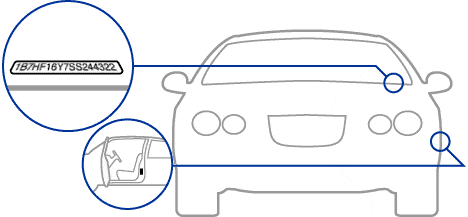
Genuine Mitsubishi assemblies are developed for the original engine, exhaust routing, oxygen-sensor positions, and underbody clearances found on models such as the Outlander, Eclipse Cross, Mirage, Lancer, and Outlander Sport. Factory-specific construction helps avoid the fabrication commonly associated with universal parts. Browse Mitsubishi catalytic converters online and verify the VIN, engine, and converter location before placing an order.

Catalytic Converter

Catalytic Converter

Catalytic Converter

Catalytic Converter

Catalytic Converter

Catalytic Converter
Bolt, Catalytic Converte

Catalytic Converter With Integrated Exhaust Manifold

Intermediate Pipe

Pre-Converter
Intermediate Pipe
No results found for "catalytic converter". Here are some helpful search tips:
- Search by a part name. Example: water pump.
- Be less specific. Example: brake instead of ceramic brake.
- Remove information such as make, year or model.
- Can't find the part you are looking for? Contact us and we'll find it for you!
Build a Complete Catalytic Converter Repair Plan
TL;DR: The correct converter must match the vehicle’s engine, emissions configuration, mounting position, and production details. Before installation, inspect the sensors and engine systems that influence exhaust temperature and fuel mixture. Replacing the converter without correcting the original cause can lead to another failure.
A catalytic converter rarely gives drivers one unmistakable warning. A damaged or restricted unit may cause hesitant acceleration, a sulfur-like odor, rattling from beneath the vehicle, increased fuel consumption, excessive floor heat, or an emissions-related warning light. Those signs justify diagnosis, but they do not prove that the converter is the only concern. Exhaust leaks, slow sensor response, ignition faults, and improper fuel delivery can produce similar symptoms.
Start With the Trouble Code, Not Just the Part Name
A catalyst-efficiency code compares readings from sensors located before and after the converter. That means a lazy or contaminated oxygen sensor can complicate diagnosis. Replacing the converter based solely on the code may not solve the problem. A technician can review sensor activity, exhaust leaks, fuel-trim data, and converter temperature before recommending replacement.
This category may include manifold converter units, front assemblies, underfloor converters, or larger converter-and-pipe sections. One useful detail is that “front” and “rear” can refer to positions in the exhaust system rather than to the front or rear axle. Review the product diagram carefully to ensure the selected component corresponds to the failed location.
Protect the New Catalyst From Excess Fuel
Converters can be damaged when unburned fuel reaches the exhaust and ignites inside the catalyst. Worn spark plugs may contribute to misfires, while leaking or poorly operating fuel injectors can create an overly rich mixture. Even a neglected air filter can affect engine airflow and combustion quality. Inspecting these related systems before installation helps reduce the risk of repeat damage.
Why Factory Geometry Matters
A genuine Mitsubishi catalytic converter assembly follows the original pipe bends, flange angles, mounting points, heat-shield clearances, and sensor-thread locations. Universal aftermarket converters may cost less at the part level, but installation can require cutting, welding, or custom adapters. OEM construction is especially valuable when surrounding components leave little room for dimensional differences.
Use the VIN to confirm the model year, engine, drivetrain, production date, emissions package, and required position. Do not rely on photos alone. Similar-looking assemblies may differ in pipe length, bracket location, or internal specification. Also check whether gaskets, nuts, bolts, shields, and sensors are included or must be ordered separately.
Key Takeaways
- Diagnose sensor activity, leaks, and fuel control before replacing the converter.
- Identify the exact converter position shown in the factory diagram.
- Correct misfires or rich-running conditions before installation.
- Use VIN-based fitment rather than appearance alone.
Frequently Asked Questions
Can a catalytic converter be cleaned instead of replaced?
Cleaning will not repair a melted, cracked, stolen, or physically damaged catalyst. Diagnosis should determine whether the issue is contamination, restriction, or permanent internal failure.
Does a new converter include oxygen sensors?
Usually not unless the product listing specifically states otherwise. Review included components before ordering.
Why does the production date matter?
Mitsubishi may revise exhaust routing or emissions components during a model year. The production date can help distinguish between assemblies that fit different build periods.